About State Succession Index
StateSuccessionIndex.org is an original platform designed to analyse the preparedness of states and territories for legal continuity, track the technical dynamics of sovereignty transitions, and assess the legal implications of state succession events globally. It is the first dedicated resource for analysing the legal consequences of sovereignty change – whether through secession, unification, annexation, cession of territory, or other shifts in statehood.
When borders shift or governments undergo substantial change, the impact on treaties and contracts, sovereign debt, financial obligations, property rights, citizenship, international responsibility, and recognition can be both immediate and far-reaching. These legal dimensions are often overlooked in mainstream geopolitical and economic analysis. The SSI offers a structured, comparative, and forward-looking framework to assess how changes in statehood affect legal continuity and international obligations.
Nothing herein constitutes legal advice, financial advice, or a formal position on the international recognition of any entity. Classifications are based on observable state practice and express declarations, not political preference.
Technical Assessment Only: The SSI measures the logistics of sovereignty – not the politics of it. We track how states manage the transition of treaties, debts, and laws, among others, to ensure global legal continuity.
In a world of increasing geopolitical volatility – from territorial disputes, armed conflicts, and independence referendums – the SSI provides a unique perspective for understanding and preparing for the legal realities of state succession.
Our Vision & Aim
States are not static entities; they can undergo changes that lead to new forms of statehood, governance, legal systems, modes of cooperation, and territorial boundaries.
The State Succession Index aims to contribute to the stability of international legal, diplomatic, and commercial arrangements; the rule of law; the protection of human rights; the peaceful resolution of disputes; and the smooth transition of states, regardless of their developmental context.
The notion of State Succession
The Index adopts an original approach to state succession in order to address the challenges that contemporary succession poses to international law and policy. In this context, the term “state succession” refers to the succession of both states and governments, with certain specific considerations. In particular, by state succession, we mean both the replacement of one State by another in the responsibility for the international relations of territory and the process by which a state fundamentally alters its structures of power and authority. In such cases, any potential disruption to existing international arrangements requires an authoritative international response.
We believe state successions will continue to happen because there are powerful centrifugal forces at work in the world. Nowadays, every succession may have significant worldwide consequences. It was once thought that only the predecessor state and its successor states were impacted by a state succession’s effect. States, organisations, businesses and population are now closely entwined in legal, political, commercial, military, and diplomatic relationships. Because of this intricate worldwide web, the state succession has a significant influence on ever-widening rings of participants and processes.
Partnership
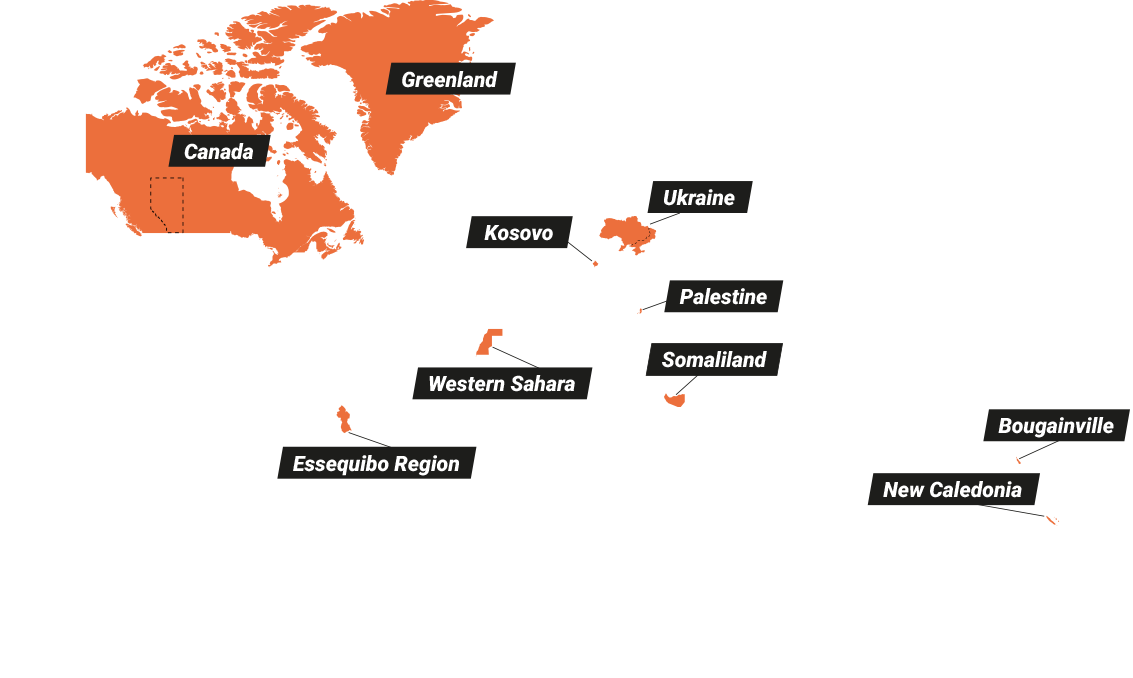
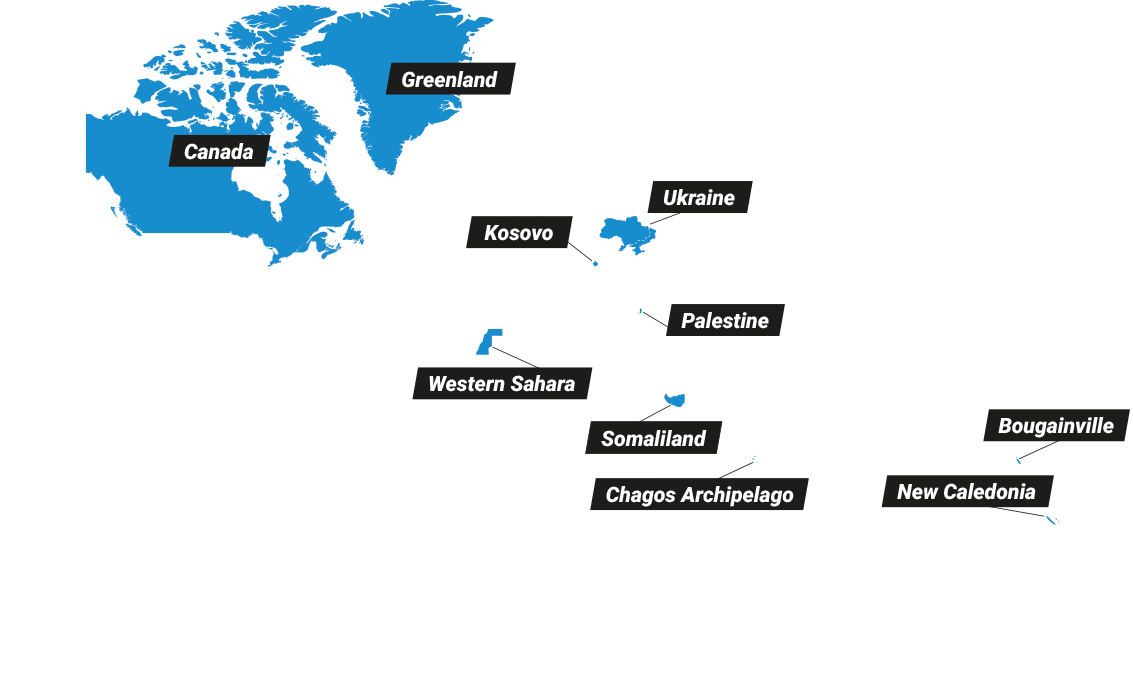
The State Succession Index (SSI) and its World Map of State Succession are designed as a transparent and evolving project. The project is open to institutional partnerships aimed at further developing its analytical depth, technical sophistication, and global coverage, while preserving analytical independence and methodological integrity.
In a fragmenting geopolitical landscape, the project seeks to provide “certainty in sovereignty” and “legal continuity” by evolving its data into an AI-driven “force multiplier” for global decision-making. We invite collaboration to transform SSI’s proprietary research into a high-fidelity analytical engine for the 2026 economy.
Partnerships may include, inter alia:
– collaborating on “Sovereign AI” agents capable of autonomous auditing and stress-testing of state succession events, debt continuity, and treaty obligations, among others;
– development of interactive, AI-enhanced, and layered versions of the World Map of State Succession;
– creation of thematic maps and automated risk models, including succession to treaties, sovereign debt, state property, and other sector-specific international obligations;
– joint research projects, expert consultations, and structured data contributions for AI training and sovereign-risk stacks;
– educational and capacity-building initiatives, including training and academic outreach; and
– consultancy and analytical support on issues of state succession, including “Sovereignty-as-a-Service” (SaaS) for institutional stakeholders.
Neutrality
The State Succession Index maintains a neutral and non-advocacy position. All partnerships are governed by the following principles:
– the project does not promote or oppose any political, territorial, or legal claims;
– classifications, visualisations, and algorithmic outputs reflect express declarations and observable state practice;
– academic independence, methodological transparency, and source integrity are preserved.
Partnerships support the analytical and institutional development of the project and do not constitute endorsement of any particular interpretation of international law or position of any state or entity.
How to Cite this Platform
State Succession Index, 2026 (www.statesuccessionindex.org), Accessed on 21/01/2026.
Contact
Institutions and experts interested in collaboration are welcome to contact the project team at:
mirbek.sydygaliev@statesuccessionindex.org